SITE UNDER CONSTRUCTION!
Overview of Cells
Cell Theory
Cell theory states two things - the base unit of function and structure is the cell and that all cells come from pre-existing cells by cell division.
The Cell
The cell is an enclosed structure, separated from the rest of the world by a partially-permeable membrane. This allows it to control traffic of materials into and out of the cell. Inside the cell, there are a number of 'ultrastructures', known as organelles. The study of cells is known as cell biology.
Cell Structure
Microscopy
Different types of microscope
There are two types of microscope - light & electron. Light uses light waves as it's source of radiation and electron microscopes use electrons. This has to do with the wavelength of the radiation - visible light ranges from 400-700nm, and for the light microscope to see a structure, that structure has to be greater than half the wavelength used, so as to interfere with the light waves and produce an image. This means the maximum resolution of a light microscope is around 200nm.
Electrons have a much smaller wavelength (at least as small as x-rays) and because they are negatively charged, they can be focused using electromagnets, whereas x-rays cannot). This allows them to see much smaller structures than light microscopes - up to and including 0.5nm, and a single DNA molecule is 2nm. Electron microscopes however do have a drawback - the specimen must be scanned in a vacuum, and since water boils at room temperature in a vacuum, all specimens must be dehydrated before being examined, and thus only dead material can be seen.
Magnification and Resolution
Optical magnification is defined as the ratio between the apparent size of an object (or its size in an image) and its actual size. It can be calculated as thus;
Resolution on the other hand, is defined as the ability to distinguish between two separate points. If the light microscope cannot distinguish between the two separate points, those two points become one in the resulting image. For example, ribosomes are approximately 22nm in diameter and when viewed with a light microscope cannot be discerned as it does not interfere with the light waves, whereas a 1000nm mitochondrion does.

Cell Organelles
An organelle is defined as both a functionally and structurally separate part of the cell and are often surrounded by membranes of their own. This is known as compartmentalisation.
Nucleus
Structure
· Largest organelle
· Dual-membrane (nuclear envelope) - porous, allowing exchange between nucleus and cell.
· Sub-structure - nucleolus
Function
· Controls cells activities
· mRNA leaves the nucleus to perform protein synthesis
· Contains chromosomes
Mitochondria
Structure
· dual membrane forming an envelope
· Inner membrane folded to form cristae, projecting to the inside of the mitochondria, known as the matrix
Function
· Perform later stages of aerobic respiration, a metabolic process that creates ATP
Also involved in lipid synthesis
Endoplasmic Reticulum
Structure
· Rough endoplasmic reticulum has its membrane surface lined with ribosomes.
· Smooth endoplasmic reticulum do not have ribosomes
· Both form a series of sheets which enclose flattened sacs called a cisternae.
Function:
· Protein synthesis takes place in ribosomes on the rough endoplasmic reticulum
· Provide a large surface area for chemical reactions and a pathway for transport of materials through the cell
· Smooth endoplasmic reticulum is involved in lipid synthesis

Golgi Apparatus
Structure
· Similar to smooth ER, more compact
Function
· Collect, process and sort molecules.
The stack of flattened sacs (cisternae) are constantly being formed by vesicles budding off at the end of smooth ER and being broken down at the other end to form Golgi vesicles.
Ribosome
Structure
· One large and one smaller subunit
· Comprise of RNA (ribosomal) and protein
· 20nm size
Function
· Protein synthesis
Lysosome
Structure
· Around 0.1-1.0µm in diameter
· Membrane surrounding digestive enzymes known as hydrolases
Functions
· Digesting worn out organelles, or bacterium taken in during phagocytosis
· Bind to the cell membrane and release their enzymes outside of it in a process known as exocytosis like exocism
Cilia and flagella
These two organelles are almost identical except that cilia are shorter and more numerous. Their structure is a two central micro tubules, surrounded by nine pairs of micro tubules on the outside, wrapped in a plasma membrane, in a long elongated shape similar to a hair. Their function can either be to move an entire organism or to move material within an organism. An example of the latter is the cilia in the trachea moving mucus along the throat.
Centriole
A centriole is a hollow cylinder formed from a ring of microtubules and used to grow the spindle fibres used in nuclear division.
Plasma Membrane
This is a very thin phospholipid bi-layer. It controls the movement of substances in and out of the cell; further explanation can be found later in this book.
Plants Only
Chloroplast
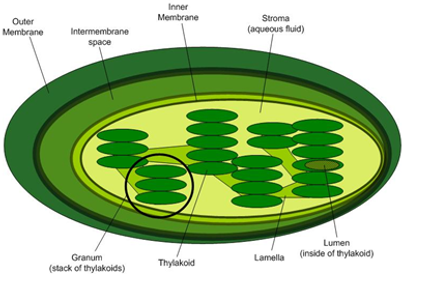
These are relatively large organelles, found only in photosynthesising cells, are green in colour due to the presence of the pigment chlorophyll, and at high magnifications grana can be seen in them. Grana are used in photosynthesis which will be discussed more later.
Vacuole
The vacuole is a fluid filled sac bound by a single membrane - it contains a solution of sugars, amino acids, waste products and mineral salts. It can serve as a temporary store, for waste or food, and can also contain hydrolytic enzymes. They also support some plants by providing an osmotic system which creates a pressure potential.
Cell Wall
Functions of the cell wall in plant cells include preventing the cell bursting when osmosis allows water to enter and provides the cell with structure and a definite shape.
Plasmodesmata
These fine strands of cytoplasm are linked through the cell wall, connecting neighbouring cells.
TABLE 1: SIMILARITIES BETWEEN ANIMAL AND PLANT CELL
|
ANIMAL CELL |
PLANT CELL |
|
Has Nucleus |
Has Nucleus |
|
Has Rough Endoplasmic Reticulum |
Has Rough Endoplasmic Reticulum |
|
Has Smooth Endoplasmic Reticulum |
Has Smooth Endoplasmic Reticulum |
|
Has Ribosome |
Has Ribosome |
|
Has Golgi Apparatus |
Has Golgi Apparatus |
|
Has Plasma Membrane |
Has Plasma Membrane |
|
Has Mitochondria |
Has Mitochondria |
|
*Has vesicles |
*Has vesicles |
|
Has Cytoplasm |
Has Cytoplasm |
TABLE 2: DIFFERENCES BETWEEN ANIMAL AND PLANT CELL
|
ANIMAL CELL |
PLANT CELL |
|
Has Cytoskeleton |
Has no cytoskeleton |
|
Has Lysosome |
Has no Lysosome |
|
Has Centriole |
Has no Centriole |
|
Has, Small, Temporary Vacuole |
Has Large, Central, Permanent Vacuole |
|
Has no Cell Wall |
Has Cell Wall |
|
Has no Plasmodesmata |
Has Plasmodesmata |
Prokaryotes and Eukaryotes
Karyote means 'nucleus' and thus prokaryote means 'before nucleus' which is an easy way to remember that these are the less complex cell type. They are also 1,000 to 10,000 times smaller than eukaryotes. Eukaryotes have a membrane bound nucleus, whereas prokaryotes have no membrane bound nucleus or no nucleus at all.
TABLE 3: DIFFERENCES BETWEEN PROKARYOTES AND EUKARYOTES
|
|
PROKARYOTES |
EUKARYOTES |
|
Typical organisms |
bacteria, archaea |
fungi, plants, animals |
|
Typical size |
~ 1-10 µm |
~ 10-100 µm (sperm cells, apart from the tail, are smaller) |
|
Type of nucleus |
No membrane bound nucleus or no nucleus at all |
nucleus with double membrane |
|
DNA |
circular (usually) |
linear molecules (chromosomes) |
|
RNA-/protein-synthesis |
coupled in cytoplasm |
RNA-synthesis inside the nucleus |
|
Ribosomes |
Smaller (18nm) |
Larger (22nm) |
|
Cytoplasmatic structure |
very few structures |
highly structured by endomembranes and a cytoskeleton |
|
Mitochondria |
none |
one to several thousand (though some lack mitochondria) |
|
Chloroplasts |
none |
in algae and plants |
|
Organization |
usually single cells |
single cells, colonies, higher multicellular organisms with specialized cells |
|
Cell division |
Binary fission (simple division) |
Mitosis (fission or budding), Meiosis |
Tissues and Organs
· Tissue: A collection of cells specialised to perform one or more functions, and the cells do not have to be of the same type - merely collectively perform the same functions.
· Organ: Composed of more than one type of tissue which forms a structural and functional unit. Leaves, the brain, the heart are all examples of organs.
· System: Collection of organs with the same function, such as the digestive system.
Epithelium
Epithelial tissue is tissue that forms sheets covering surfaces and both the types you are required to learn about are said to be simple epithelia as they are one cell thick. They rest on a basement membrane, which is NOT a cell membrane, but rather a network of collagen and glycoproteins and holds the epithelium cells in place.
Squamous Epithelium
Squamous Epithelium is very smooth, flat and thin - they fit together like floor tiles providing a smooth almost frictionless surface over which fluids can move easily. The thickness (or lack thereof) in epithelium aids in processes like diffusion. This type of epithelium cell covers many surfaces in the body, for example the inner surfaces of atria and blood vessels. It also forms alveoli walls.
Ciliated Epithelium
This is epithelium with cilia and is found for example in the trachea, where it is tall and narrow and the cilia is used to waft mucus along the trachea.
Glandular Epithelium
This is epithelium with cells that excrete some substance in the body. Some substances it secretes include hormones, mucous, and lubricating fluid.